
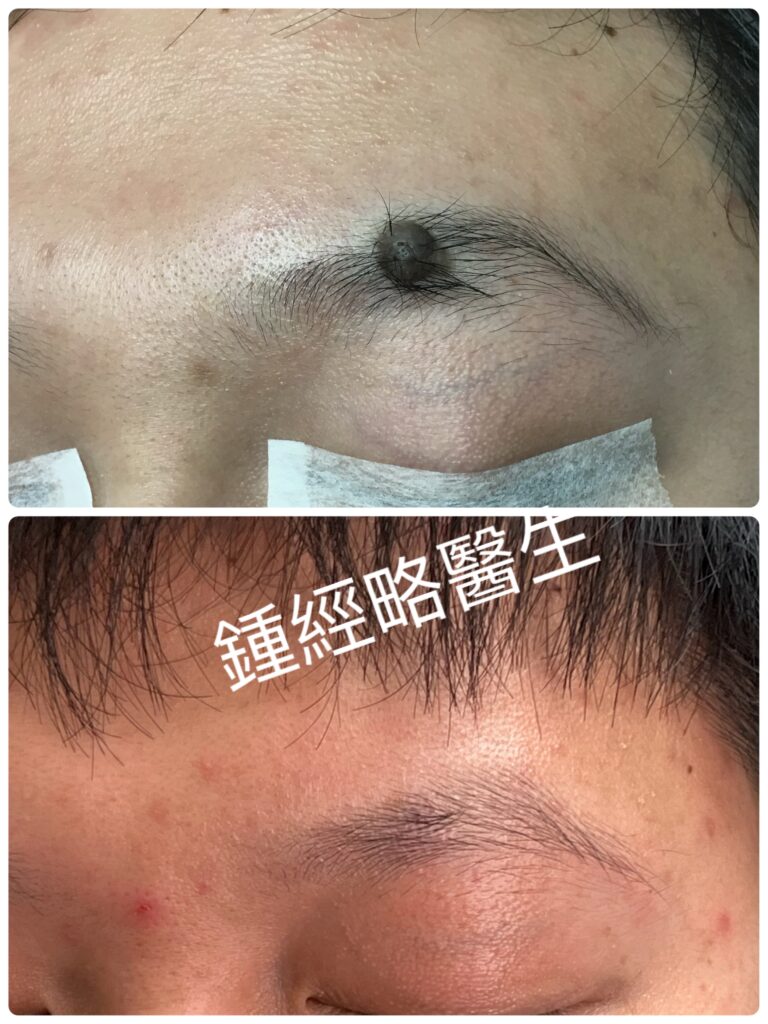
Comparative Overview of Eyebrow Mole Removal Modalities
Key Advantages of CO2 Laser Ablation
1. Preserving Eyebrow Hair Follicles
The eyebrow region contains a dense cluster of oblique hair follicles. These follicles root deeply within the superficial and deep dermis.
- The Laser Advantage: CO2 lasers (10,600 nm) operate via selective photothermolysis, directly targeting intracellular water. Consequently, a skilled clinician vaporizes microscopic layers down to the nest of the nevus cells. This precise approach prevents thermal damage to neighboring follicle bulbs.
- The Surgical/Chemical Risk: Conversely, standard excision cuts directly through the hair-bearing dermis. Consequently, this creates a permanent line of hair loss (alopecia) along the scar. Similarly, chemical corrosion and deep cautery destroy hair roots indiscriminately, leaving patchy eyebrow defects.
2. Controlling Depth and Heat Coagulation
- Thermal Boundary Management: The CO2 laser seals small dermal blood vessels (<0.5 mm) instantly. At the same time, it leaves a narrow zone (30-50 μm) of lateral thermal damage.
- Controlled Depth: By removing the mole layer by layer under magnification, the clinician stops precisely at the reticular dermis. This prevents deep, indented scarring.
3. Minimizing Scars and Blending Edges
Traditional scalpel excision requires primary closure with sutures. This process introduces tension vectors across the supraorbital skin and leaves linear scar tissue. In contrast, CO2 laser ablation leaves a clean, flat, circular wound. Most laser mole removals require no sutures. As a result, the wound creates no skin tension. It avoids pulling on adjacent tissue. Thus, it prevents distortion around important organs eg the eyes or mouth, avoiding dysfunction and scarring.
Comparison with Alternative Modalities
1. Cold-Steel Surgical Excision
- Surgical Advantage: Excision yields an intact tissue specimen for histopathological biopsy. This step remains essential if a clinician suspects malignancy.
- CO2 Advantage: For strictly benign dermal or compound nevi confirmed by dermoscopy, the CO2 laser avoids suturing entirely. This eliminates suture marks (“railroad track” scarring) and preserves local eyebrow symmetry.
2. Chemical Corrosion (Trichloroacetic Acid / TCA)
- Chemical Risk: Acid application lacks depth control. Consequently, liquefactive necrosis spreads laterally or seeps deeper into the dermis, causing irregular ulceration, hyperpigmentation, or severe hypertrophic scarring.
- CO2 Advantage: Optical laser precision replaces unpredictable chemical reactions.
3. Cryotherapy (Liquid Nitrogen)
- Cryotherapy Risk: Melanocytes are exceptionally sensitive to sub-zero temperatures. Therefore, cryotherapy frequently destroys surrounding melanocytes, leading to permanent post-inflammatory hypopigmentation (a bright white patch in the eyebrow).
- CO2 Advantage: Thermal vaporization targets water in nevus cells directly. This preserves neighboring epidermal pigmentation predictably.
4. Electrocautery / Monopolar Diathermy
- Electrocautery Risk: In addition, electrocautery relies on uncalibrated electrical resistance heat. Consequently, this causes widespread collateral thermal damage. Specifically, it produces a zone of necrosis that often exceeds 500μm). This collateral injury slows healing and increases scarring risks.
- CO2 Advantage: Ultra-pulsed CO2 laser energy delivers high peak power in ultra-short bursts. As a result, it vaporizes target tissue faster than heat can diffuse into surrounding healthy skin.
Mandatory Pre-Procedure Triage
Ablative laser procedures vaporize tissue completely, preventing subsequent histopathological examination. Therefore, prior to proceeding with CO2 laser removal:
- Dermoscopic Verification: First, a dermatologist or qualified specialist must conduct a thorough examination. Specifically, this step is essential to rule out clinical signs of dysplasia, basal cell carcinoma (BCC), or melanoma.
- Biopsy Requirement: To begin with, any lesion exhibiting structural asymmetry, irregular borders, multiple colors, or recent growth requires immediate evaluation. Consequently, it must undergo a formal punch or shave biopsy rather than primary laser vaporization.
眉毛痣去除方式之比較概述
CO2 激光氣化去除的核心優勢
1. 保存眉毛毛囊
眉毛區域密佈傾斜生長的毛囊,這些毛囊深植於真皮淺層至深層。
- 激光優勢: CO2 激光(波長 10,600 nm)根據選擇性光熱作用原理運作,精準以細胞內水分為目標。因此,經驗豐富的醫生能以微米級的精度逐層氣化,直達痣細胞巢,避免熱損傷波及鄰近的毛囊根部。
- 手術/化學風險: 相反,傳統切除術會直接切走長有眉毛的真皮層,在疤痕處留下永久性的線狀脫毛(無毛症)。同樣地,化學腐蝕與深層電灼會無差別地破壞毛囊根部,導致眉毛出現斑塊狀毛髮缺損。
2. 精準控制深度與熱凝固效果
- 熱損傷邊界管理: CO2 激光能即時封閉微小的真皮血管(<0.5mm),同時將側向熱損傷範圍嚴格控制在極窄的區域(30-50 μm)。
- 控制深度: 在放大鏡下逐層清除痣組織,醫生可精準停在真皮網狀層,從而防止形成深層凹陷性疤痕。
3. 減少疤痕並使邊緣自然過渡
傳統手術刀切除需要使用縫線進行一期縫合,這會在眉骨上方皮膚引入張力向量,並留下線狀疤痕組織。
相比之下,CO2 激光氣化會留下平整、乾淨的圓形傷口。大多數激光去痣手術都不需要縫合。因此,傷口不會產生皮膚拉力,避免拉扯鄰近組織。這樣可以防止眼部或口部等重要器官變形,避免造成功能障礙和疤痕。
與其他替代療法的比較
1. 傳統手術切除
- 手術優勢: 切除術可提供完整的組織標本,用於病理組織學活檢。若醫生懷疑患有惡性腫瘤,此步驟至關重要。
- CO2 優勢: 對於經皮膚鏡確認為純良性的真皮痣或混合痣,CO2 激光可完全免去縫合,從而消除縫線痕跡,並保留局部眉型對稱。
2. 化學腐蝕(三氯乙酸 / TCA)
- 化學風險: 塗抹酸性物質缺乏深度控制。因此,液化性壞死會向四周擴散或向真皮深層滲透,導致不規則潰瘍、色素沉澱或嚴重的增生性疤痕。
- CO2 優勢: 以光學激光的精準度取代不可預測的化學反應。
3. 冷凍治療(液態氮)
- 冷凍風險: 黑色素細胞對零下低溫極為敏感。因此,冷凍治療經常破壞周圍的黑色素細胞,導致永久性發炎後色素脫失(眉毛區域出現白色斑塊)。
- CO2 優勢: 熱氣化直接以痣細胞中的水分為目標,能可預測地保留鄰近表皮的色素沉著。
4. 電灼術 / 單極電熱
- 電灼風險: 電灼術依賴未經校準的電阻熱,會造成廣泛的 collateral 熱損傷(壞死區域往往超過 500μm)。這種附加損傷會延緩癒合並增加留疤風險。
- CO2 優勢: 超脈衝 CO2 激光能量可在極短的脈衝內釋放高峰值功率。結果是,它氣化目標組織的速度遠快於熱量擴散至周圍健康皮膚的速度。
術前必須進行的分流評估
氣化激光療程會完全氣化組織,無法進行隨後的病理組織學檢查。因此,在進行 CO2 激光去痣前:
- 皮膚鏡檢查確認: 必須由皮膚科碩士醫生(或以上資格)或合資格專家進行詳細檢查,以排除異常增生、基底細胞癌或黑色素瘤等臨床徵兆。
- 活檢要求: 任何呈現結構不對稱、邊緣不規則、多重顏色或近期有增大跡象的病變,必須接受正式的打孔活檢(Punch biopsy)或刮除活檢(Shave biopsy),而非直接進行激光氣化。