A solitary cutaneous lesion was surgically excised from the glabellar region, located on the lower forehead near the nasal root, slightly left of midline and in close proximity to a branch of the supratrochlear artery.
The lesion was irregular in shape, with ill-defined borders, and demonstrated heterogeneous light brown pigmentation. It appeared raised approximately 0.5 cm above the surrounding skin surface.
Histologic examination showed it was a benign intradermal nevus.
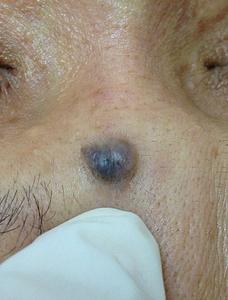
a black skin mole, benign in nature, was on the glabella area of this patient’s face. There were some hairs growing from the mole.
圖示黑色癦痣長在眉間,良性,有毛長出
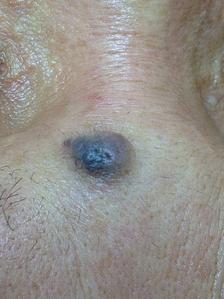
close up view of the hairy skin mole
有毛癦痣的近觀
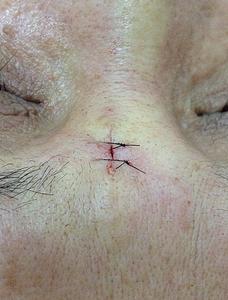
after excision of the skin mole, the wound was sutured up. the excess hairs growing from that skin mole were also removed in the process as well. The wound was closed with 4’o nylon suture.
癦痣切除後傷口以4/O尼龍線縫合,連同那些毛也一併移除.
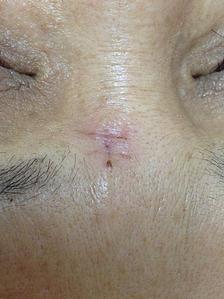
one week after surgery, the nylon suture was removed, scar was seen.
圖示手術一星期後拆線,可見有傷疤
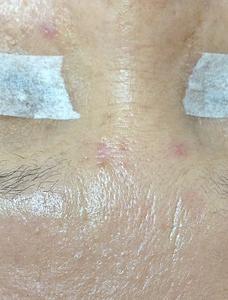
one week after the stitches were removed, the scar faded, and became barely visible.
圖示拆線後一星期,傷疤已消失得幾乎看不見了.
Essay: Challenges of Excision of a Skin Mole in the Glabellar Area
The glabellar region—the area between the eyebrows and above the nasal root—is one of the most delicate and cosmetically sensitive sites on the face. Excision of a mole in this location presents unique difficulties and challenges that require both surgical precision and aesthetic judgment.
1. Anatomical Complexity
- The glabella lies close to important vascular structures, including branches of the supratrochlear artery and vein. Injury to these vessels can lead to bleeding, hematoma, or prolonged bruising.
- The skin is relatively thin, and underlying muscles (procerus, corrugator supercilii) are active in facial expression. This increases tension on the wound and raises the risk of scar widening.
2. Cosmetic Sensitivity
- The glabellar area is central to facial appearance. Even small scars are highly visible.
- Patients often have high cosmetic expectations, making meticulous closure essential.
- Any asymmetry between the eyebrows or irregularity in contour can be noticeable and aesthetically displeasing.
3. Lesion Characteristics
- Moles in this region may be raised, pigmented, or hairy, as described in the case.
- Ill‑defined borders or irregular pigmentation complicate excision, requiring careful margin control to ensure complete removal while minimizing unnecessary tissue loss.
4. Technical Challenges in Excision
- Achieving precise depth control is critical. Depth should be down to subcutis but down to periosteum is often not necessary.
- Suturing must be performed with fine non‑absorbable sutures (e.g., 4‑0 nylon) to minimize track marks.
- The wound lies in a high‑mobility area; tension from frowning or eyebrow movement can impair healing.
5. Postoperative Considerations
- Scar maturation in the glabella requires careful monitoring. Even minor hypertrophy or pigmentation can be conspicuous.
- Patients must avoid excessive facial expressions, rubbing, or trauma to the site during healing.
- Sun protection is essential to prevent post‑inflammatory hyperpigmentation.
6. Balancing Function and Aesthetics
- The surgeon must balance complete lesion removal with preservation of natural contour.
- Over‑aggressive excision may distort the brow line, while conservative excision risks recurrence.
- Artistic judgment is as important as surgical skill in this region.
Conclusion
Excision of a mole in the glabellar area is challenging due to its vascular anatomy, cosmetic prominence, and dynamic movement. Success depends on precise surgical technique, meticulous suturing, and careful postoperative care. When performed skillfully, as in Dr. Chung King Lueh’s case, scars can fade to near invisibility, but the procedure demands heightened awareness of both medical and aesthetic factors.
論文:眉間區域痣切除的挑戰
眉間區域——位於兩眉之間、鼻根上方——是面部最精細且美容敏感度最高的部位之一。在此區域切除痣,存在獨特的困難與挑戰,需要兼具外科精準度與美學判斷。
1. 解剖學複雜性
- 眉間鄰近重要血管結構,包括滑車上動脈與靜脈分支。若損傷這些血管,可能導致出血、血腫或持續瘀青。
- 該區皮膚相對薄,且下方肌肉(如降眉肌、眉皺肌)在面部表情中活躍,增加傷口張力並提高疤痕擴大的風險。
2. 美容敏感性
- 眉間位於面部中央,即使是細小疤痕也極為顯眼。
- 患者通常對美容效果有很高期待,因此縫合必須細緻。
- 眉毛之間的任何不對稱或輪廓不規則都會明顯且影響美觀。
3. 病灶特徵
- 此區域的痣可能呈現突起、色素沉著或伴隨毛髮。
- 邊界不清或色素不均會增加切除難度,需要精確控制切緣,以確保完整切除並避免不必要的組織損失。
4. 切除技術挑戰
- 精確控制深度至關重要:通常切至皮下組織即可,無需深入至骨膜。
- 縫合需使用細緻不可吸收縫線(如 4‑0 尼龍),以減少縫線痕跡。
- 傷口位於高活動區域,皺眉或眉毛運動造成的張力可能影響癒合。
5. 術後考量
- 眉間疤痕成熟需仔細監測,即使輕微的肥厚或色素沉著也會顯眼。
- 患者在癒合期間必須避免過度面部表情、摩擦或外傷。
- 術後防曬至關重要,以防止炎症後色素沉著。
6. 功能與美觀的平衡
- 醫師必須在完整切除病灶與保持自然輪廓之間取得平衡。
- 過度切除可能破壞眉線,而過於保守則有復發風險。
- 在此區域,藝術性的判斷與外科技術同樣重要。
結論
眉間痣切除因其血管解剖、中央美容位置及動態活動而充滿挑戰。成功取決於精準的外科技術、細緻的縫合以及嚴謹的術後護理。若操作得當,如鍾經略醫生的案例,疤痕可淡化至幾乎不可見,但此手術需要醫師對醫學與美學因素有高度敏感度。