
上眼皮脫墨
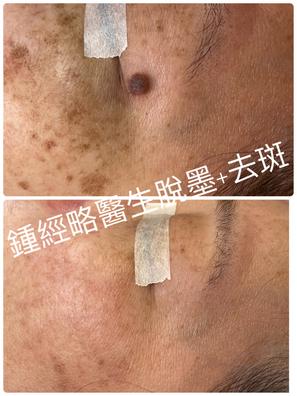
This is a pre and post operative photo of CO2 laser mole removal and PICO 532nm laser solar lentigo removal
Case Report: Combined CO₂ Laser Mole Removal and Pico 532 nm Solar Lentigo Treatment
Patient Background
A 58‑year‑old woman with no significant past medical history presented with a raised brown mole on the lateral aspect of her left upper eyelid. The lesion had been present for over 30 years, was slow‑growing, and exhibited benign features (no ulceration, no rapid enlargement). She had never undergone cosmetic medical treatments before.
In addition, she complained of multiple solar lentigines—tens of light to dark brown macules—distributed across her face, with a history of more than 20 years.
Procedure
The patient underwent CO₂ laser ablation of the eyelid mole. The lesion was vaporized together with its root to prevent recurrence. Precise depth control was critical: too shallow an ablation risks recurrence with scarring, while too deep an ablation risks unnecessary tissue loss and deformity. In this case, the depth was controlled accurately, resulting in complete removal without relapse.
At the same session, she also received pico 532 nm laser treatment for all facial solar lentigines. Performing both procedures simultaneously was demanding for both patient and physician, given the need for meticulous wound care and the extent of facial treatment.
Postoperative Course
- Upper eyelid wound: Required careful wound care and oral antibiotics to prevent infection. Healing took 2–3 weeks, leaving a red/pink slightly depressed scar that gradually faded over 5 months.
- Facial solar lentigines: After pico laser, the entire face became red and swollen; this subsided within half a day. Scabs formed and took about one week to peel off. By one week after treatment, the complexion appeared even, clear, and radiant.
Outcome
At 5 months post‑operation, the scar on the upper eyelid was almost invisible to the naked eye. The facial skin, after solar lentigo removal, appeared bright and clear. The patient expressed high satisfaction with the cosmetic outcome.
Discussion
This case highlights the technical demands of CO₂ laser mole removal in the upper eyelid region, where thin skin, high tension, and proximity to ocular structures pose challenges. It also demonstrates the effectiveness of combining CO₂ laser with pico 532 nm treatment in a single session, achieving excellent cosmetic results with careful postoperative management.
病例報告:CO₂ 激光上眼皮脫墨合併 Pico 532 nm 激光治療日光性雀斑
患者背景
患者為 58 歲女性,無重要既往病史。左上眼瞼外側有一顆隆起的棕色痣(墨),已存在超過 30 年,生長緩慢,具備良性特徵(無潰瘍、無快速增大)。患者過去從未接受過任何美容醫療治療。
此外,她面部散佈有數十枚淺棕至深棕色的日光性雀斑,病史超過 20 年。
上眼皮脫墨之手術過程
患者接受 CO₂ 激光汽化去除上眼瞼痣(上眼皮墨)。病灶連同根部一併汽化,以防止復發。精準控制汽化深度至關重要:
- 過淺:根部未完全去除,可能復發並同時留下疤痕。
- 過深:切除過多正常組織,會造成不必要的疤痕或變形。
本病例中,汽化深度控制精確,痣(墨)完全去除,無復發,疤痕極小。
同一療程中,患者亦接受 Pico 532 nm 激光治療,針對全臉日光性雀斑。兩項治療同時進行,對患者與醫生而言均具挑戰性,因為需要細緻的傷口護理以及面部大範圍治療。
術後過程
- 上眼瞼(眼皮)傷口:需謹慎護理並口服抗生素以防感染。癒合時間約 2–3 週,留下紅/粉色輕微凹陷疤痕,約 5 個月逐漸淡化。
- 面部雀斑:Pico 激光後全臉紅腫,半天內消退。形成痂皮,約一週脫落。一週後膚色均勻、清透、光澤。
結果
上眼皮脫墨手術後 5 個月,眼皮(眼瞼)的疤痕幾乎肉眼不可見。面部雀斑去除後,膚色明亮清潔。患者對美容效果非常滿意。
討論
此病例顯示,上眼瞼痣(上眼皮墨)的 CO₂ 激光去除在技術上極具挑戰,因為皮膚薄、張力大且鄰近眼部結構。同時進行 CO₂ 激光與 Pico 532 nm 激光治療需要醫師高度的臨床經驗與精準操作。妥善的術後管理確保了優異的美容效果。
Essay: Comparing CO₂ Laser Mole Removal and Pico 532 nm Solar Lentigo Removal
Introduction
Laser technology has revolutionized dermatology, offering precise and minimally invasive options for treating skin lesions. Two commonly used modalities—CO₂ laser and Pico 532 nm laser—serve distinct purposes. While both are effective, their mechanisms, applications, and challenges differ significantly.
CO₂ Laser Mole Removal
- Mechanism: CO₂ lasers emit infrared light at 10,600 nm, absorbed strongly by water in tissues. This produces vaporization of targeted cells.
- Application: Ideal for raised lesions such as moles, skin tags, and warts. The laser ablates tissue layer by layer, including the mole’s root, to prevent recurrence.
- Depth Control: Critical for success.
- Too shallow → incomplete removal, risk of relapse, and scarring.
- Too deep → unnecessary tissue loss, deformity, and scarring.
- Challenges:
- Thin skin regions (e.g., eyelids, ear tragus) have high tension and limited circulation, complicating healing.
- Risk of infection if wound care is inadequate.
- Requires meticulous technique and extensive experience to balance complete removal with minimal scarring.
Pico 532 nm Laser Solar Lentigo Removal
- Mechanism: Pico lasers deliver ultra‑short pulses (picoseconds) at 532 nm wavelength, targeting melanin pigment. The rapid energy shatters pigment particles without significant thermal damage to surrounding tissue.
- Application: Best suited for flat pigmented lesions such as solar lentigines, freckles, and post‑inflammatory hyperpigmentation.
- Healing Process:
- Redness and swelling typically subside within hours.
- Scabs form and peel off within about a week.
- Skin tone becomes more even, clear, and radiant.
- Advantages:
- Minimal downtime compared to ablative lasers.
- Low risk of scarring since the treatment is pigment‑specific rather than tissue‑ablative.
- Challenges:
- Requires multiple sessions for extensive pigmentation.
- Post‑treatment care is essential to avoid hyperpigmentation or recurrence.
Key Differences
| Aspect | CO₂ Laser | Pico 532 nm Laser |
|---|---|---|
| Target | Tissue (raised mole, lesion root) | Pigment (melanin in lentigines) |
| Wavelength | 10,600 nm (infrared) | 532 nm (visible green) |
| Mechanism | Vaporizes tissue via water absorption | Shatters pigment via photoacoustic effect |
| Risk | Scarring, infection, deformity if depth mismanaged | Temporary redness, swelling, scabbing |
| Healing Time | 2–3 weeks for wound closure, months for scar fading | 1 week for scabs to peel, redness subsides in hours |
| Outcome | Permanent removal of raised lesion | Clearer, more even skin tone |
Conclusion
CO₂ laser and Pico 532 nm laser represent two distinct approaches in dermatology: one ablative, targeting tissue for mole removal, and the other pigment‑specific, targeting melanin for solar lentigo clearance. Both demand precision and experience, but their risks, healing processes, and cosmetic outcomes differ. When combined in a single session, as in the case described, they demonstrate the versatility of modern laser technology in achieving comprehensive aesthetic improvement.
論文:CO₂ 激光痣(墨)去除與 Pico 532 nm 激光日光性雀斑去除的技術比較
引言
激光技術已徹底改變皮膚科的治療方式,提供精準且微創的皮膚病灶處理方法。常用的兩種技術——CO₂ 激光與 Pico 532 nm 激光——各有不同的作用機制與適應症。雖然兩者都有效,但在機制、應用及挑戰上存在顯著差異。
CO₂ 激光痣去除
- 作用機制:CO₂ 雷射發射波長 10,600 nm 的紅外光,強烈被組織中的水分吸收,進而汽化細胞。
- 適應症:適合處理隆起性病灶,如痣、皮膚贅生物、疣等。激光逐層汽化組織,連同痣的根部一併去除,以防復發。
- 深度控制:成功的關鍵。
- 過淺 → 根部未完全去除,可能復發並留下疤痕。
- 過深 → 過度切除正常組織,造成不必要的疤痕或變形。
- 挑戰:
- 在皮膚薄、張力大的區域(如眼瞼、耳屏)操作困難。
- 術後若護理不足,感染風險高。
- 需要醫生高度經驗與精準技術,才能兼顧完整去除與最小疤痕。
Pico 532 nm 激光日光性雀斑去除
- 作用機制:Pico 激光以極短脈衝(皮秒級)輸出 532 nm 波長,專一性作用於黑色素。能快速擊碎色素顆粒,而不造成顯著熱損傷。
- 適應症:適合平坦的色素性病灶,如日光性雀斑、雀斑、炎症後色素沉著。
- 癒合過程:
- 術後紅腫通常數小時內消退。
- 約一週痂皮脫落。
- 一週後膚色均勻、清透、光澤。
- 優點:
- 與汽化型激光相比,恢復期短。
- 因為專一性針對色素,疤痕風險低。
- 挑戰:
- 面積廣或色素深者可能需多次治療。
- 術後護理若不當,可能出現色素沉著或復發。
主要差異
| 面向 | CO₂ 激光 | Pico 532 nm 激光 |
|---|---|---|
| 作用目標 | 組織(隆起性痣、病灶根部) | 色素(黑色素顆粒) |
| 波長 | 10,600 nm(紅外線) | 532 nm(綠光) |
| 作用機制 | 透過水分吸收汽化組織 | 光聲效應擊碎色素 |
| 風險 | 疤痕、感染、變形 | 暫時紅腫、痂皮 |
| 癒合時間 | 傷口癒合需 2–3 週,疤痕淡化需數月 | 紅腫數小時消退,痂皮約一週脫落 |
| 效果 | 永久去除隆起病灶 | 膚色均勻、清透、亮麗 |
結論
CO₂ 激光與 Pico 532 nm 激光代表皮膚科的兩種不同策略:前者屬於汽化型,針對組織去除痣;後者則是色素專一型,針對黑色素清除雀斑。兩者皆需精準操作與臨床經驗,但在風險、癒合過程與美容效果上各有不同。若在同一療程中結合使用,正如案例所示,能展現現代激光技術在全面美容改善上的多樣性與優勢。