【注意:本文章及真實病人照片均源自鍾經略醫生的臨床皮膚科碩士及美容醫學碩士課程案例,屬於原創醫學文獻。因此,本院嚴格保留所有版權。同時,我們禁止任何形式的轉載與複製。】
手術案例闡述:
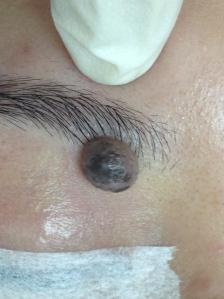
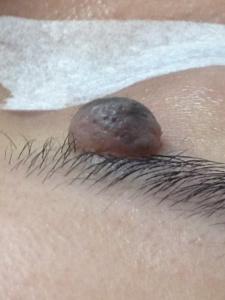
一顆良性的「眼眉毛內大癦」部份生長於眉毛區域內。該病灶呈隆起狀,為深褐色、色素分佈不均的單一病變,從周圍皮膚表面突起約 0.9 公分。病灶本體的最大橫向直徑為 1. 1 公分,基底直徑約為 0.9 公分。
病灶邊緣清晰、界線分明,未見不規則擴散或侵犯周邊組織。表面可見終毛(永久毛)生長,約有 4 至 5 根毛髮自病灶中長出。該痣已存在約 30 年,除了體積慢慢逐漸變大之外,顏色或形態上沒有明顯變化。
Case presentation:
A benign nevus is located partially within the region of the eyebrow. This lesion appears as a single raised spot. It has an uneven dark brown color. In addition, it sits about 0.9 cm above the surrounding skin. The maximal transverse diameter of the lesion body is 1.4 cm, with a basal diameter of approximately 1.0 cm.
The margins are distinct and well-defined, with no evidence of irregularity or infiltration into adjacent tissue. The surface demonstrates terminal hair growth, with approximately 4 to 5 hairs emerging from the lesion. This mole has been present for about 30 years. During this time, it has shown no changes in size, color, or shape.
脫墨前
這粒「眼眉毛內大癦」部份位於右邊眉毛的內下側,生長時間已經20年以上。不癢不痛。屬於良性的墨痣。可以用激光去除。近鏡觀察癦痣,明顯凸出於皮膚以上。
激光手術之前,先用麻醉膏把皮膚表面的痛感減少,然後注射麻醉針,然後才用激光把墨痣無痛去除。
近鏡
激光脫癦後
近鏡觀察脫墨後的傷口。傷口明顯塌陷下去,傷口還有少少流血。
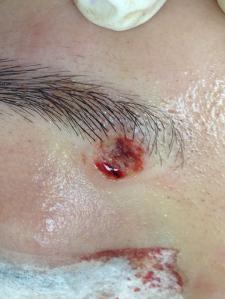
這類較深且向內凹陷的傷口,周圍血管分布豐富,而且沒有縫線,處理難度較高,需要特殊的傷口修復技巧。經過鍾經略醫生悉心且專業的治療後,傷口癒合效果理想,疤痕幾乎看不出來。
激光切割出來的癦痣
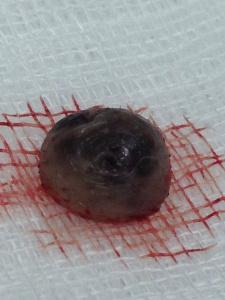
小心護理傷口,服食抗生素,盡力減低皮膚發炎。加上鍾經略醫生有大量處理大型傷口的經驗,經過他的特殊處理,傷口恢復的幾乎不見疤痕
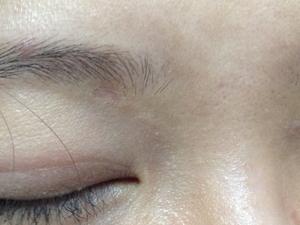
數個星期後傷口癒合,近鏡觀察。傷口已經變得不明顯。而且此等微細的疤痕會隨著時間,進一步減淡。
案例討論:二氧化碳激光切除眉內側巨大黑色隆起痣 – 倫理與實務現實
引言
位於右眉內側的一顆巨大黑色隆起痣(眼眉毛內大癦),不僅帶來美容上的困擾,亦可能影響功能。由於其處於面部顯眼位置,切除不僅是醫學操作,更是美學干預。二氧化碳(CO₂)激光切除已成為此類病灶的精準且美容效果良好的技術,具有瘢痕小、恢復快的優勢。更為重要的是,CO₂激光切除可提供完整的組織標本作病理學檢查,從而保障不同專科醫生甚至全科醫生在診斷惡性病灶時的安全性。
醫生角色
一般人常以為只有皮膚科專科醫生才最適合進行痣的切除。然而,事實更為複雜。對於良性且美容意義重大的痣,最佳效果往往來自於那些兼具皮膚科訓練與美容醫學/外科經驗的醫生。這類醫師既理解醫學安全性,又能兼顧面部精細區域的美學效果。
事實上,許多皮膚科專科醫生會將痣的外科切除轉介予外科醫生,而他們自身並不常親自操作。皮膚科醫生的優勢在於診斷與疾病管理,但並非所有人都常規進行切除。相反,兼具皮膚科與醫學美容訓練的醫生,往往能在安全與美學之間取得最佳平衡。
診斷考量
只有皮膚科專科醫生才能明確診斷惡性痣的情況是很少見的。在大多數存在不確定性的情形下,無論是皮膚科醫生或全科醫生,標準做法都是切除病灶並送病理檢查。如果執行手術的醫生具有深厚皮膚訓練(碩士或以上)亦同時擁有美容醫學碩士(或以上)資格,這樣既能排除惡性可能,又能同時滿足患者的美容需求。
因此,關鍵在於:診斷和切除痣並不一定需要皮膚科專科醫生,尤其是良性痣。最重要的是切除後的組織必須送病理檢查。無論操作者是皮膚科醫生、具皮膚科訓練的全科醫生,外科醫生或是醫學美容醫生,真正的診斷保障在於病理學,而非操作者的頭銜。
倫理與實務現實
在許多地區,美容師為顧客去除痣並不屬違法,儘管此舉在無菌、診斷與安全方面存在隱憂。合理的做法是:美容師僅在醫生確認痣為良性,且不位於主要血管、神經或重要器官(如眼睛、鼻孔、耳朵等)附近時,才進行非手術性去痣。換句話說,此程序可由美容師執行,但必須在合資格醫生的監督下進行。對於醫生而言,關鍵的安全保障仍在於組織送病理檢查。只要這一環節得到落實,在常規良性痣切除中,皮膚科醫生與具皮膚科訓練的全科醫生之間的差別便不再顯著。
CO₂激光切除技術
CO₂激光切除在面部敏感區域的大型隆起痣中具有多重優勢:
精準性:激光透過組織汽化,幾乎無旁損,可精確切斷痣的基底,同時保留主體作病理檢查。
安全性:切除的組織可送病理檢查以排除惡性。以上案例就是用二氧化碳激光把該墨痣凸出的地方切除,然後送往組織檢查。
止血性:激光可封閉小血管,減少出血。
美容效果:激光操作更精細準確,瘢痕較傳統手術更小,尤其適用於面部。
高效性:操作時間短,恢復快。
對於右眉內側的巨大黑色隆起痣,CO₂激光切除能在完整去除病灶的同時,精細修整眉形線條。術後必須將標本送病理檢查以確認良性。
結論
右眉內側巨大黑色痣的CO₂激光切除案例揭示了一個更廣泛的事實:痣的切除效果並不局限於皮膚科專科醫生。兼具「皮膚科」與「美容醫學」訓練的醫生往往能提供更優的美容結果。真正的安全保障在於切除組織的病理學檢查,以確保排除惡性。最終,患者的最大受益在於醫學安全與美學藝術的有機結合。
Discussion: CO₂ Laser Excision of a Large Pigmented Mole on the Medial Eyebrow – Ethical and Practical Realities
Introduction
A large, raised pigmented mole on the medial side of the right eyebrow presents both cosmetic and functional concerns. Its prominence in a highly visible facial area makes excision not only a medical procedure but also an aesthetic intervention. CO₂ laser excision is a precise technique for these lesions. It delivers minimal scarring and a rapid recovery. Moreover, this method yields a valid specimen for histological examination. As a result, it protects practitioners across specialties—including dermatologically trained GPs—from misdiagnosing malignant lesions.
The Role of the Practitioner
It is often assumed that only dermatology specialists are best suited for mole removal. In reality, doctors achieve the best outcomes for benign, cosmetically significant moles by blending deep dermatology training with aesthetic precision. First, these practitioners evaluate the medical safety of the lesion. Next, they apply refined cosmetic artistry to preserve delicate facial features. Consequently, this dual expertise ensures both safety and excellent visual results.
Many dermatology specialists, in fact, refer surgical mole excision cases to surgeons rather than performing the procedure themselves. Their strength lies in diagnosis and disease management, but not all dermatologists routinely carry out excisions. Conversely, physicians with dual training in dermatology and aesthetic medicine/surgery (e.g. MSc Clinical Dermatology AND MSc Aesthetic Medicine) are often uniquely positioned to balance medical safety with cosmetic precision.
Diagnostic Considerations
There are relatively few cases where only a dermatology specialist can definitively diagnose a mole. In most situations where uncertainty exists, the standard practice—whether by a dermatology specialist or a GP with profound dermatology training—is to excise the lesion and send the specimen for histopathological examination. This ensures malignancy is ruled out while simultaneously addressing the patient’s cosmetic concerns if the operation is carried out by a doctor with DUAL MASTER in Dermatology and Aesthetic Medicine.
The key point is that a dermatology specialist is not always required to diagnose and remove a mole, particularly a benign one. What matters most is that the excised specimen is properly submitted for histology. Whether the practitioner is a dermatologist, a GP with dermatology training, or an aesthetic surgeon, the diagnostic safeguard lies in pathology, not in the operator’s title.
Ethical and Practical Realities
In many jurisdictions, it is not even illegal for beauticians to remove moles for their clients, though this practice raises concerns about sterility, safety, and diagnostic oversight. A reasonable approach is that beauticians may carry out non-surgical mole removal only after a doctor has confirmed the mole is benign and not located near major blood vessels, nerves, or vital structures such as the eye, nostril, or ear. In another word, the procedure may be performed by a beautician, but it must be conducted under the supervision of a qualified doctor. For doctors, the critical safeguard remains the submission of tissue for histological examination. As long as this step is observed, the distinction between a dermatologist and a GP with dermatology training becomes less significant in routine benign mole removal.
CO₂ Laser Excision Technique
CO₂ laser excision offers several advantages for large raised moles on cosmetically sensitive areas such as the eyebrow:
Precision: The laser vaporizes tissue with minimal collateral damage, allowing accurate excision of the mole’s stem while preserving the excised body for histology examination.
Safety: The specimen can be sent for histological examination to rule out malignancy. This case demonstrates the excision of a raised skin mole using CO₂ laser, with the excised specimen submitted for histological examination to ensure patient safety.
Hemostasis: The laser seals small vessels, reducing bleeding.
Cosmetic outcome: The refined accuracy of the laser reduces scarring compared to scalpel excision, especially in facial regions.
Efficiency: The procedure is relatively quick, with short downtime.
For a large black raised mole on the medial eyebrow, CO₂ laser excision allows careful contouring to preserve the natural brow line while removing the lesion completely. Post-procedure, histology remains essential to confirm benignity.
Conclusion
The case of CO₂ laser excision of a large pigmented mole on the medial eyebrow illustrates a broader truth: excellence in mole removal is not confined to dermatology specialists. Doctors with combined training in dermatology and aesthetic medicine or surgery often deliver superior cosmetic results. The essential safeguard lies in histological examination of excised tissue, ensuring malignancy is excluded. Ultimately, the patient benefits most when medical safety and aesthetic artistry are seamlessly integrated in the treatment approach.