Clinical Essay: Challenges in CO₂ Laser Ablation of a Mole on the Nasal Tip
Introduction
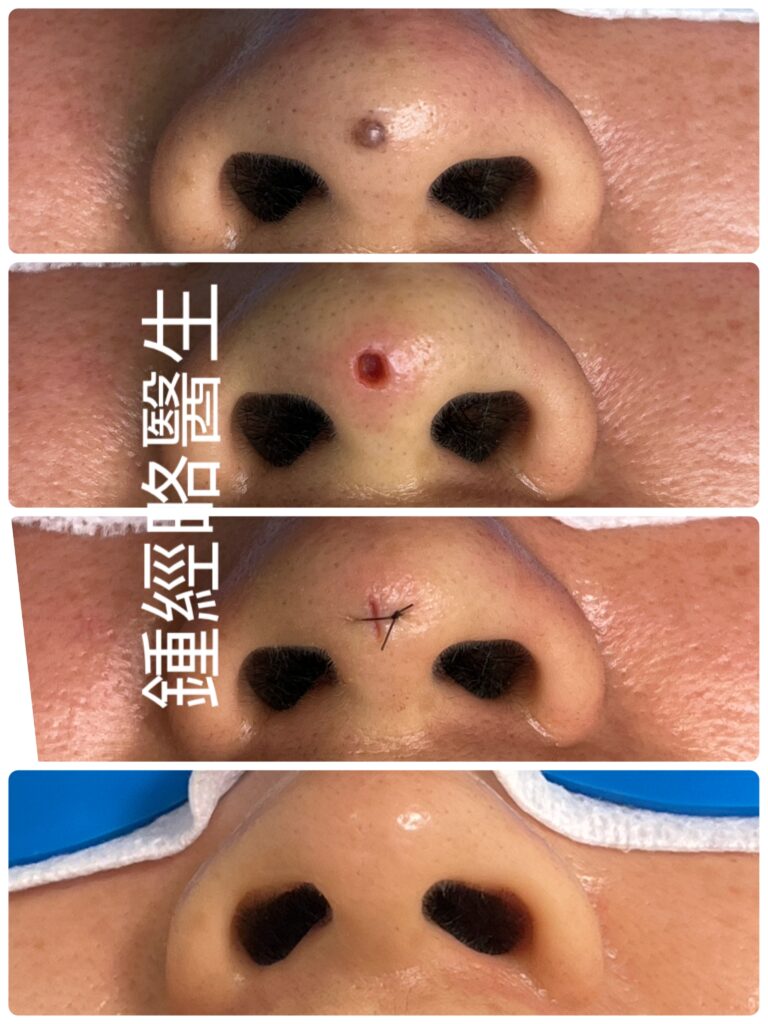
The nasal tip is one of the most cosmetically sensitive and anatomically complex regions of the face. Removing a mole in this area with CO₂ laser ablation requires meticulous technique and significant clinical experience.
Challenges
- High Tension on Convex Surface
- The nasal tip is convex, with tight and thin skin.
- Wounds here are under constant tension, increasing the risk of stretching and scar formation.
- Poorer Circulation
- Although the blood supply to the nasal tip is generally abundant, circulation becomes compromised after suturing. The skin over the nasal tip and bridge is tight and firmly adherent to the underlying cartilage, with minimal subcutaneous tissue. As a result, tension at the suture line is high, reducing perfusion in and around the wound. If infection occurs, the already poor circulation makes it difficult to control, and healing may ultimately leave a conspicuous and cosmetically unsightly scar.
- However, suturing may speed up healing and reduce scar formation if the wound is deep.
- Presence of Sweat and Sebaceous Glands
- The nasal tip contains abundant sweat and sebaceous glands.
- Increased excretion can contaminate the wound, raising infection risk.
- Mechanical Stress During Sleep
- The protruding nasal tip is prone to pressure against pillows during sleep.
- This can stretch the wound, cause bleeding, or impair healing.
- Impact of Allergic Rhinitis
- Patients with allergic rhinitis often need to blow their nose frequently.
- This repetitive mechanical irritation can disrupt wound healing and increase scar formation.
- Cosmetic Visibility
- The nasal tip is convex, shiny, and reflects light.
- Even subtle scars become highly visible, making cosmetic outcomes particularly challenging.
Conclusion
Laser ablation of a mole on the nasal tip is technically demanding due to anatomical tension, poor circulation, glandular secretions, mechanical stress, and cosmetic visibility. Achieving optimal results requires precise depth control, careful wound management, and extensive patient education. Ultimately, surgical experience and judgment are critical in minimizing scarring and ensuring satisfactory cosmetic outcomes in this high‑risk region.
臨床論文:鼻尖痣 CO₂ 雷射汽化去除的挑戰 (鼻尖脫墨)
引言
鼻尖是臉部最具美容敏感性與解剖複雜性的區域之一。在此部位進行痣的 CO₂ 雷射去除,需要極為精細的技術與豐富的臨床經驗。
挑戰
1. 凸面張力大
- 鼻尖呈凸面,皮膚緊繃且薄。
- 此處傷口長期承受張力,增加牽拉與疤痕形成的風險。
2. 血液循環較差
- 雖然鼻尖的血液供應通常相當充足,但在縫合後循環卻容易受影響。鼻尖與鼻樑上的皮膚緊繃,並且緊密附著於下方的軟骨,皮下組織極為有限。因此,縫合線上的張力很高,導致傷口及周圍區域的灌流下降。若傷口發生感染,由於局部血液循環不良,感染往往難以控制,癒合後可能留下顯眼且不美觀的疤痕。
- 然而,若傷口較深,縫合仍可能加速癒合並減少疤痕形成。
3. 汗腺與皮脂腺豐富
- 鼻尖含有大量汗腺與皮脂腺。
- 分泌物增加傷口污染風險,提升感染可能性。
4. 睡眠時的機械性壓力
- 鼻尖突出,睡眠時容易壓迫枕頭。
- 可能造成傷口牽拉、出血或癒合不良。
5. 過敏性鼻炎的影響
- 過敏性鼻炎患者常需頻繁擤鼻涕。
- 重複的機械性刺激會干擾傷口癒合並增加疤痕形成。
6. 美容可見性
- 鼻尖為凸面,表面光亮並反射光線。
- 即使極細微的疤痕也會非常明顯,美容挑戰更大。
結論
鼻尖痣的雷射汽化去除 (鼻尖脫墨) 在技術上極具挑戰,原因包括解剖張力、血液循環不足、腺體分泌、機械壓力及美容可見性。要獲得最佳效果,必須精準控制深度、謹慎處理傷口並加強患者教育。最終結果仍取決於醫師的臨床經驗與判斷,以最大程度減少疤痕並確保滿意的美容效果。