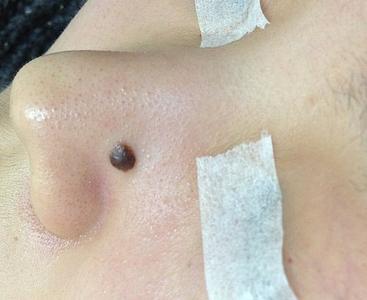
激光脫墨前 - 一粒生長在鼻子上面的黑色的凸起的墨痣
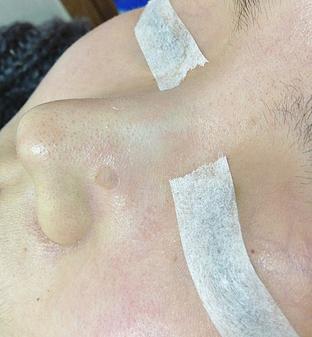
激光脫墨後 - 激光脫墨後,傷口非常細小而且淺薄,復原速度快,疤痕風險低。
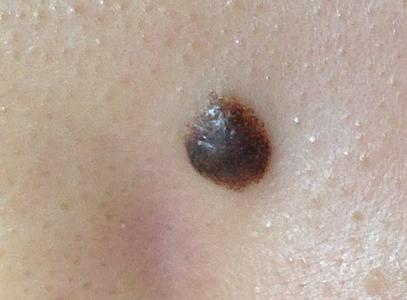
近鏡,激光脫墨前
close-up shot: the appearance of a black skin mole on the nose
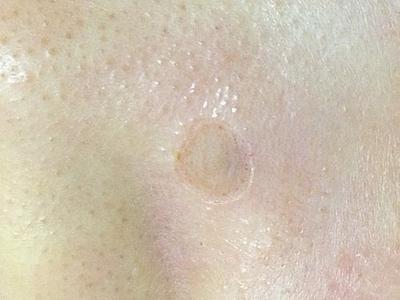
近鏡,激光脫墨後
close-up shot: After laser mole removal, the wound is very tiny and superficial, allowing for quick recovery and minimal scarring risk.
Essay: Challenges of CO₂ Laser Excision of a Nasal Mole
The nose is among the most technically demanding sites for mole removal. Its anatomy, cosmetic prominence, and healing dynamics make CO₂ laser excision particularly challenging.
1. Anatomical Considerations
- Nasal skin is thin and tightly adherent to cartilage and bone, leaving minimal subcutaneous cushion.
- The nasal bridge is supplied by both internal carotid (ophthalmic branches) and external carotid (facial/maxillary branches), with the dorsal nasal artery (internal carotid) being the dominant contributor. It emerges near the medial canthus, passes above the medial palpebral ligament, and descends along the nasal bridge. Another supply is the lateral nasal artery (external carotid) which runs along the lateral aspect of the nose, supplying the nasal ala and tip. Other arteries include columellar artery, infraorbital artery, and external nasal artery. This underscores the need for caution in surgical and aesthetic procedures. Injury to these vessels can cause bleeding, hematoma, impaired healing, infection, and visible scarring
- The nose’s three‑dimensional contour complicates uniform laser ablation and requires precise angling.
2. Cosmetic Sensitivity
- As the central facial feature, even small scars on the nose are highly visible.
- Patients often expect near‑scarless outcomes, demanding meticulous technique.
- Any irregularity in contour or pigmentation is immediately noticeable and aesthetically displeasing.
3. Technical Challenges with CO₂ Laser
- Depth control: The CO₂ laser must ablate tissue layer by layer, stopping precisely at the mole’s root while avoiding damage to underlying cartilage. If the wound is unnecessarily deep, a depressed scar may form. Conversely, if ablation is too shallow and fails to remove the entire root, the mole may recur within scar tissue.
- The goal is to achieve the minimal effective depth, ideally eliminating the need for suturing. When suturing is unavoidable, it is technically difficult due to the nasal anatomy: thin skin, little subcutaneous cushion, and bone or cartilage directly beneath. As a result, sutured wounds may appear wrinkled or uneven, complicating cosmetic refinement.
- In such cases, careful undermining of surrounding tissue and precise wound edge alignment are essential to reduce irregularity and achieve a smoother postoperative appearance.
- Thermal damage: Excess energy risks collateral tissue injury, prolonging healing.
- Precision: The curved nasal surface requires careful manipulation of the handpiece to maintain even ablation.
4. Suturing and Wound Closure (no suturing is needed in this case)
- Suturing is inherently difficult due to limited soft tissue; wound edges may appear puckered.
- Fine sutures with minimal tension are required to reduce track marks.
- Occasionally, undermining or extending the incision is necessary to redistribute tension and achieve smoother closure.
- Proper alignment with natural nasal creases is critical for camouflage.
5. Postoperative Challenges
- Scar maturation must be monitored closely; hypertrophic or pigmented scars are especially conspicuous on the nose.
- Patients must avoid trauma, rubbing, or exaggerated facial expressions during healing.
- Sun protection is vital to prevent post‑inflammatory hyperpigmentation.
- Swelling may persist longer due to the region’s vascularity.
6. Balancing Function and Aesthetics
- Complete lesion removal must be balanced with preservation of nasal contour.
- Over‑aggressive excision risks deformity, while conservative excision risks recurrence.
- Both surgical skill and aesthetic judgment are equally important in this central facial area.
Conclusion
CO₂ laser excision of a mole on the nose is challenging because of thin skin, vascularity, cosmetic prominence, and complex contours. Success depends on precise depth control, meticulous suturing, and careful postoperative care. When performed skillfully, scars can fade to near invisibility, but the procedure demands heightened awareness of both medical and aesthetic factors.
論文:鼻部痣以 CO₂ 雷射切除的挑戰
鼻子是痣切除中最具技術挑戰性的部位之一。其特殊的解剖結構、顯著的美容敏感性以及癒合動態,使得 CO₂ 雷射切除在此區域特別困難。
1. 解剖學考量
- 鼻部皮膚薄且緊貼於軟骨與骨骼之上,幾乎沒有皮下緩衝組織。
- 血管分布豐富,增加術中出血與術後瘀青的風險:
鼻樑同時由內頸動脈系統(眼動脈分支)與外頸動脈系統(顏面動脈/上頷動脈分支)供血,其中以來自內頸動脈的眶上鼻背動脈為主要供應來源。此動脈在內眥附近出現,經過內眥韌帶上方,再沿著鼻樑下降。
另一重要供應來自外頸動脈的外側鼻動脈,它沿著鼻子的外側走行,為鼻翼與鼻尖提供血流。其他相關動脈包括鼻柱動脈、眶下動脈以及外鼻動脈。
這些血管形成密集的吻合網絡,突顯了在外科與美容手術中必須謹慎操作的重要性。若不慎損傷這些血管,可能導致出血、血腫、癒合不良、感染以及明顯的疤痕。 - 鼻子為三維立體結構,曲面使雷射汽化更難保持均勻。
2. 美容敏感性
- 鼻子是面部的中心特徵,即使細小疤痕也極為顯眼。
- 患者通常期望近乎無疤痕的效果,因此技術必須極為精細。
- 輪廓或色素的任何不規則都會立即顯現並影響美觀。
3. CO₂ 雷射的技術挑戰
- 深度控制:雷射必須逐層汽化組織,精確停留在痣的“根部”,避免損傷下方軟骨。若切除過深,可能形成凹陷性疤痕;若過淺未能完全去除根部,則可能導致痣在疤痕中復發。
- 臨床目標是達到最小有效深度,以避免縫合。然而若必須縫合,因鼻部解剖特殊,操作極為困難。皮膚薄、缺乏皮下緩衝,骨與軟骨緊貼其下,導致縫合後傷口邊緣容易皺褶或不平整,增加美容修飾難度。
- 在此情況下,需進行仔細的皮下分離(undermining)並精確對齊傷口邊緣,以減少不規則並獲得更平整的術後外觀。
- 熱損傷:能量過大可能造成周邊組織損傷,延長癒合時間。
- 精準度:鼻部曲面要求醫師小心調整雷射手柄角度,以保持均勻汽化。
4. 縫合與傷口閉合(本案不需要縫合)
- 由於軟組織有限,縫合困難,傷口邊緣可能出現不平整或收縮。
- 需使用細緻、低張力的縫線以減少縫線痕跡。
- 有時需透過皮下分離或延長切口來重新分配張力,達到更平整的閉合效果。
- 與鼻部自然皺摺對齊對於疤痕遮掩至關重要。
5. 術後挑戰
- 鼻部疤痕成熟需密切監測,肥厚或色素沉著在此區域更顯眼。
- 患者在癒合期間必須避免摩擦、外傷或過度面部表情。
- 術後防曬至關重要,以防止炎症後色素沉著。
- 由於血管豐富,腫脹可能持續較久。
6. 功能與美觀的平衡
- 醫師必須在完整切除病灶與保持鼻部自然輪廓之間取得平衡。
- 過度切除可能造成變形,而過於保守則有復發風險。
- 在此區域,外科技術與美學判斷同樣重要。
結論
鼻部痣的 CO₂ 雷射切除因皮膚薄、血管豐富、美容敏感度高及立體結構而充滿挑戰。成功取決於精準的雷射深度控制、細緻的縫合以及嚴謹的術後護理。若操作得當,疤痕可淡化至幾乎不可見,但此手術需要醫師對醫學與美學因素有高度敏感度。